You’ve been scrolling through home listings, saving your favorites, and maybe even driving through neighborhoods to see what’s available. Then comes the question almost every potential homebuyer eventually asks: How much house can I actually afford?
The answer isn’t simply based on your salary or the maximum mortgage amount a lender may approve. Your existing debt, credit score, down payment, interest rate, monthly expenses, and the ongoing costs of homeownership all play a role.
Understanding those factors before you start seriously shopping can help you establish a realistic homebuying budget and avoid falling in love with a home that could leave your finances stretched too thin.
At Calhoun Liberty Credit Union, we help members throughout Florida understand their borrowing options and make informed decisions about major financial milestones like buying a home.
How Do Lenders Determine How Much House You Can Afford?
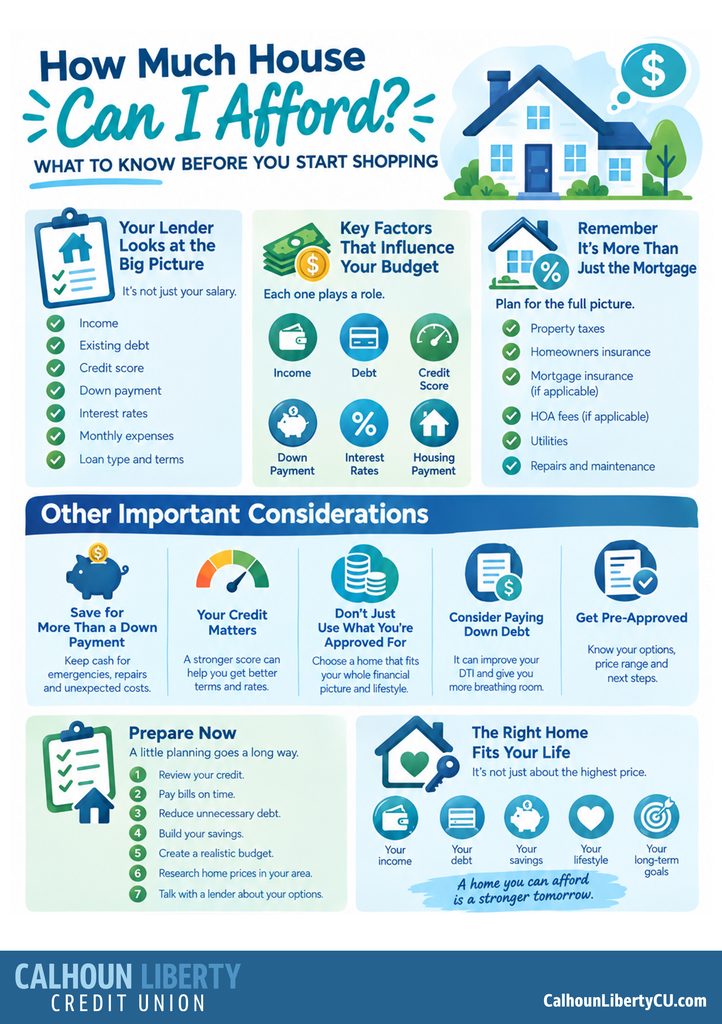
When you apply for a mortgage, lenders look at your overall financial picture rather than one number.
Some of the biggest factors include:
- Your income
- Your existing monthly debt
- Your credit history and credit score
- Your available down payment
- Current mortgage interest rates
- The estimated monthly housing payment
- The type and terms of the mortgage
Two people earning the same salary could potentially qualify for very different mortgage amounts depending on their other financial obligations.
That’s why determining how much home you can afford starts with understanding your complete budget.
Start With Your Monthly Income
Your income is an important starting point because lenders need to determine whether you have sufficient income to make your mortgage payments.
Depending on your circumstances, qualifying income may include sources such as:
- Salary or hourly wages
- Self-employment income
- Certain consistent secondary income
- Retirement income
- Other qualifying income sources
But earning a certain amount doesn’t automatically mean you should spend a particular percentage of it on a home. Your existing obligations matter, too.
How Does Debt Affect How Much House You Can Afford?
One of the most important numbers you’ll encounter when preparing for a mortgage is your debt-to-income ratio, often called DTI.
Your debt-to-income ratio compares your monthly debt obligations with your gross monthly income.
Existing obligations could include:
- Auto loans
- Student loans
- Personal loans
- Minimum credit card payments
- Other recurring debts
The more of your monthly income that’s already committed to debt, the less room you may have in your budget for a mortgage payment.
If homeownership is a future goal, paying down existing debt before buying may improve your financial position and potentially expand your mortgage options.
How Does Your Credit Score Affect Buying a House?
Your credit score can have a significant impact on mortgage financing.
Lenders use your credit history as one factor in evaluating your application. Depending on the mortgage program and other qualifications, stronger credit may help you access more favorable loan terms or interest rates. Why does that matter so much?
Because even a difference in your mortgage interest rate can affect both your monthly payment and how much interest you pay over the life of the loan.
If you’re thinking about buying a home, review your credit well before you plan to apply. That gives you time to identify potential errors and work on areas that may need improvement.
Helpful habits include:
- Paying bills on time
- Reducing credit card balances
- Avoiding unnecessary new debt
- Reviewing your credit reports
- Keeping your overall debt manageable
You don’t necessarily need perfect credit to become a homeowner, but understanding where you stand can help you prepare.
How Much Do You Need for a Down Payment?
You’ve probably heard that you need 20% down to buy a house. That’s not always the case.
Down payment requirements vary depending on the mortgage program, borrower qualifications, and other factors. Some buyers may qualify for options requiring less than 20% down.
However, the amount you put down still matters.
A larger down payment may:
- Reduce the amount you need to borrow
- Lower your monthly principal and interest payment
- Reduce the total interest paid over time
- Affect whether mortgage insurance is required
The right down payment isn’t necessarily the largest amount you can possibly scrape together. You should also consider how much savings you’ll have left after closing.
Don’t Empty Your Savings Just to Buy the House
This is an important one. Putting every dollar you’ve saved toward a home purchase could leave you vulnerable the first time something goes wrong. And when you own a home, something eventually will.
The air conditioner stops working. The water heater needs replacing. An appliance dies. The roof needs attention. Unlike renting, there isn’t a landlord responsible for those expenses.
Before deciding how much cash to put toward a home, consider maintaining savings for:
- Emergencies
- Moving expenses
- Initial repairs
- Furniture and appliances
- Home maintenance
- Unexpected costs after closing
Buying the house is only the beginning of the financial responsibility of homeownership.
Your Mortgage Payment Isn’t Your Only Housing Expense
Another common mistake is comparing a potential mortgage payment directly with your current rent. Owning a home involves additional expenses.
Your total housing costs may include:
- Mortgage principal and interest
- Property taxes
- Homeowners insurance
- Mortgage insurance protection, if applicable
- Homeowners association fees, if applicable
- Utilities
- Repairs and maintenance
Property taxes and insurance can vary considerably depending on the property and location, so they need to be part of your affordability calculation from the beginning.
For Florida homebuyers in particular, understanding the cost of homeowners insurance is an important part of creating a realistic housing budget.
Just Because You’re Approved for It Doesn’t Mean You Have to Spend It
Suppose you’re approved to borrow more than you expected. Great news! But your maximum approval isn’t necessarily your ideal homebuying budget.
Think about the life you want to have after you buy the house. Ask yourself:
- Can I comfortably make this payment every month?
- Will I still be able to save?
- Can I handle an unexpected home repair?
- Will I have room in my budget for groceries, transportation, and other necessities?
- Can I continue working toward other financial goals?
- Will I still have money to enjoy my life?
Being able to make a mortgage payment and being comfortable making that payment are two different things.
The right home price should leave room for both.
Should You Pay Off Debt Before Buying a House?
Not necessarily all of it. Whether you should pay down debt before applying for a mortgage depends on the type of debt, your savings, your income, and your overall financial situation.
However, reducing high monthly debt obligations may help improve your debt-to-income ratio and free up more room in your monthly budget. The key is balance.
Draining your entire savings account to eliminate a relatively manageable debt could leave you without money for a down payment or emergency expenses. On the other hand, carrying significant high-interest debt into homeownership can create additional financial pressure.
This is another reason it’s helpful to start preparing well before you’re ready to make an offer.
How Much House Can I Afford on My Salary?
There’s no universal home price that corresponds to a particular salary. Online calculators and general rules of thumb can provide a starting estimate, but they can’t account for every part of your financial life.
For example, two households earning $80,000 per year might have completely different budgets.
One may have:
- No car payments
- Minimal credit card debt
- Significant savings
The other may have:
- Two vehicle payments
- Student loans
- Credit card balances
- Limited savings
Their comfortable homebuying budgets aren’t going to be identical simply because their incomes are.
Rather than asking only, “How much house can I afford on my salary?”, consider asking:
“What monthly housing payment comfortably fits my entire financial picture?”
That’s a much more useful number.
Should You Get Pre-Approved Before Looking at Houses?
If you’re getting serious about buying, mortgage pre-approval can give you a much clearer understanding of your financing options before you begin making offers.
The process can help you understand:
- How much you may be able to borrow
- What loan options may be available
- An estimated price range
- Potential monthly payments
- What documentation you’ll need
It can also help you shop more confidently because you’re looking at homes within a more realistic price range.
Keep in mind that pre-approval isn’t a guarantee of final loan approval. Your financial situation, the property, documentation, and other factors still need to meet applicable lending requirements.
Preparing to Buy a Home? Start Before You Find the House
If buying a home is on your radar (even if you’re not quite ready yet) there are things you can do now to put yourself in a stronger position.
Start by:
- Reviewing your credit.
- Paying bills on time.
- Reducing unnecessary debt.
- Building your savings.
- Creating a realistic monthly budget.
- Researching home prices in the areas you’re considering.
- Talking with a lender about mortgage options and what you may need to qualify.
You don’t have to wait until you’ve found your dream house to start preparing for homeownership. In fact, starting earlier can make the entire process easier when the right home does come along.
Take the Next Step Toward Homeownership
So, how much house can you afford?
The best answer isn’t simply the highest price a calculator gives you. It’s a home with a monthly cost that works alongside your income, debt, savings, lifestyle, and long-term financial goals.
At Calhoun Liberty Credit Union, we’re here to help members throughout Florida understand their financing options and prepare for homeownership with confidence.
Whether you’re buying your first home, planning your next move, or simply trying to figure out what you can afford, starting the conversation early can help you make a more informed decision when you’re ready.
Serving Homebuyers Across Florida
Calhoun Liberty Credit Union proudly serves members throughout Alachua, Baker, Bay, Bradford, Brevard, Broward, Calhoun, Charlotte, Citrus, Clay, Collier, Columbia, Miami-Dade, DeSoto, Dixie, Duval, Escambia, Franklin, Flagler, Gadsden, Gilchrist, Glades, Gulf, Hamilton, Hardee, Hendry, Hernando, Highlands, Hillsborough, Holmes, Indian River, Jackson, Jefferson, Lafayette, Lake, Lee, Leon, Levy, Liberty, Madison, Manatee, Marion, Monroe, Nassau, Okaloosa, Okeechobee, Osceola, Pasco, Polk, Putnam, Santa Rosa, Sarasota, Sumter, Suwannee, Taylor, Union, Volusia, Wakulla, Walton, and Washington Counties.
If you’re considering buying a home in Florida, our team can help you better understand your mortgage options and what to consider before taking the next step.
Frequently Asked Questions About Home Affordability
How much house can I afford based on my income?
Income is only one factor used to determine home affordability. Your existing debt, credit history, down payment, mortgage rate, taxes, insurance, and other monthly expenses also affect how much home you can comfortably afford.
How much of my income should go toward a mortgage?
There’s no single percentage that’s right for every household. Lenders evaluate debt-to-income ratios when reviewing mortgage applications, but your personal budget should also account for savings, everyday expenses, home maintenance, and other financial goals.
Do I need 20% down to buy a house?
Not necessarily. Down payment requirements vary by mortgage program and borrower qualifications. Some buyers may qualify for mortgage options requiring less than a 20% down payment. By not having the 20% down, you will be required to purchase MIP Mortgage Insurance Protection until the loan is paid down below the dollar amount of the 20% needed.
Does my credit score affect how much house I can afford?
It can. Your credit history may affect the mortgage programs, interest rates, and terms available to you. Because your interest rate affects your monthly payment, it can also influence overall affordability.
Should I get pre-approved before looking for a house?
Getting pre-approved before seriously shopping can help you understand your potential borrowing options and establish a more realistic price range. It can also help you prepare for making an offer when you find the right home.
What expenses should I consider besides the mortgage payment?
Homebuyers should account for property taxes, homeowners insurance, potential mortgage insurance, HOA fees where applicable, utilities, maintenance, repairs, and other ongoing homeownership expenses.